Real-Time Programs
Real-Time Operations & Broadcast Infrastructure
Architecting High-Volume Media Pipelines for Live and Interactive Simulation Environments
I spearhead the engineering and deployment of live, interactive virtual environments that bridge bleeding-edge render engines with public space installations. By architecting agile workflows using Unreal Engine, Future.Stage, Unity, and NVIDIA Omniverse, I focus on low-latency telemetry integration, live motion-capture puppeteering, and high-volume hybrid broadcast pipelines. This framework is proven to successfully modernize legacy intellectual property for live audience interaction (Moon Mouse) while simultaneously sustaining a continuous, rolling network broadcast schedule of weekly, monthly, and mission-critical telemetry events for global academic stakeholders.
Moon Mouse Case Study:
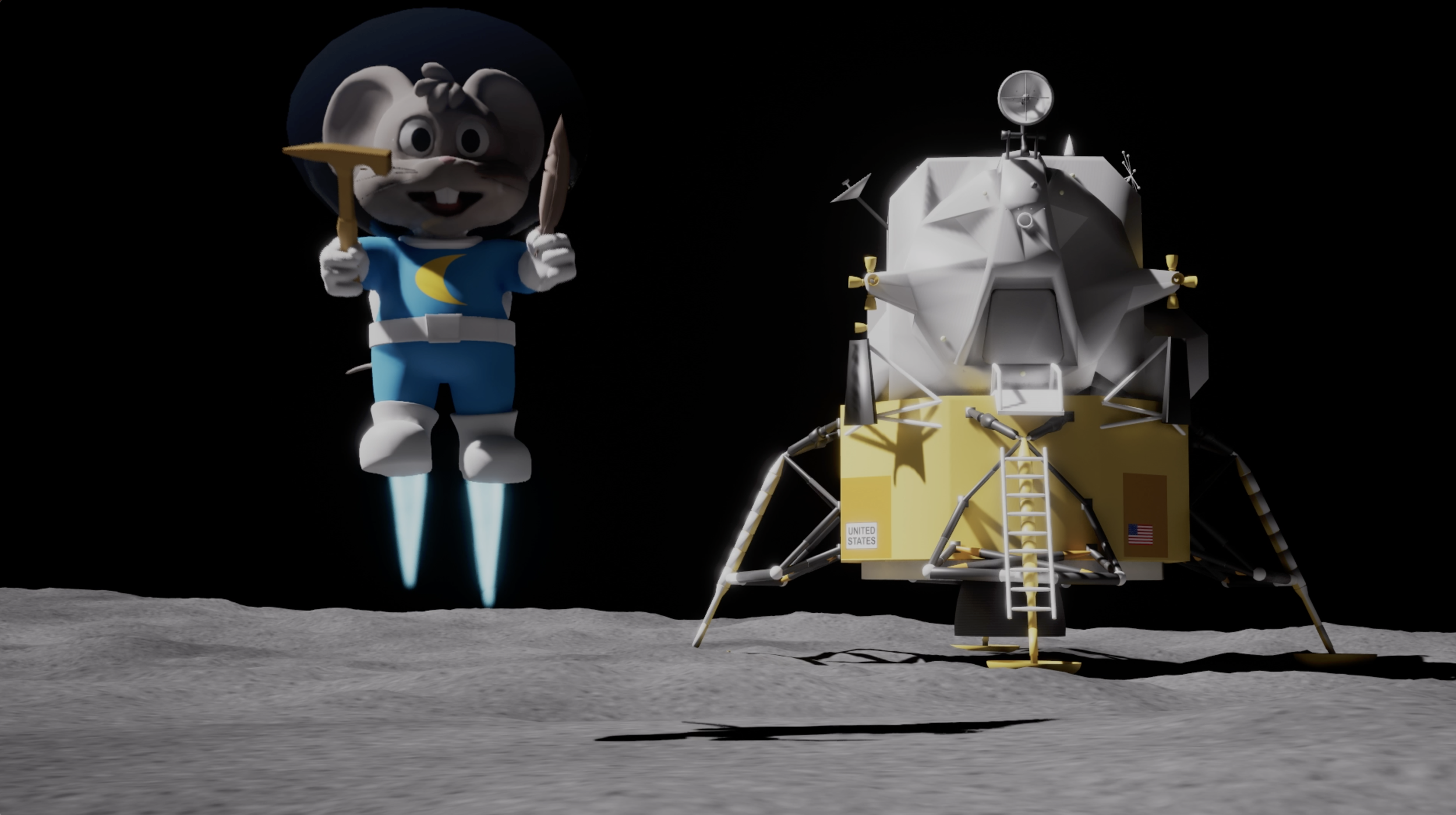
This flagship virtual production initiative was designed to modernize legacy studio intellectual property into a state-of-the-art interactive guest experience. By establishing a creative co-development pipeline with the Academy of Art University and utilizing Unreal Engine alongside Future.Stage frameworks, we engineered a live, real-time animated program. The final architecture bridges advanced character rigging, multi-source camera tracking, and live motion-capture telemetry, allowing public program presenters to puppeteer and voice a 3D character in real-time response to live audience interaction.
Early Screening of Moon Mouse for audience testing on public floor.
Detailed Case Study Breakdown
IntellIntellectual Property Modernization & University Co-Development: To honor institutional legacy while pushing technical boundaries, I spearheaded the revival of Moon Mouse—a beloved character originally created 30 years ago by retired Morrison Planetarium Assistant Director Bing Quock. Senior Technical Director Jeroen Lapré and I established a strategic production partnership with the Academy of Art University, directing an agile workflow where Jeroen Lapré co-managed a team of advanced digital media students. Together, we oversaw the end-to-end asset generation pipeline, translating historical 2D concepts into highly sophisticated, modern 3D meshes optimized for complex real-time skeletal rigging, texturing, and environmental programming.
Unreal Engine Engineering & Studio System Integration: Once the foundational student modeling phase concluded, we transitioned the project to our internal team at the California Academy of Sciences Visualization Studio to engineer the heavy-duty technical integration. Utilizing Unreal Engine and Future.Stage frameworks, we led the development of a highly stable real-time rendering environment capable of running flawlessly in a public floor exhibit. We oversaw the creation of a dual-camera closed-loop framework: one system mapped to capture live audience telemetry, and a parallel node directed at a concealed performer, establishing a low-latency feedback loop that enables instantaneous, unscripted improvisational performance.
Public Programs Enablement & Live Performance Architecture: The true success of the project relied on transforming complex engineering into a seamless tool for live public presenters. We managed the pipeline that integrated real-time motion-capture acting with live audio-routing systems, enabling public program hosts to step into the virtual suit of the character. By combining hardware tracking with live performance training, we created an active, living exhibit where the virtual character naturally reacts, speaks, and locks eyes with visitors. This framework redefines how scientific institutions can leverage real-time entertainment architectures to build deep, emotional community engagement.